

Co-Owner & Host, Honey Badger
Brooklyn, NY
Participating In: Into the Wild

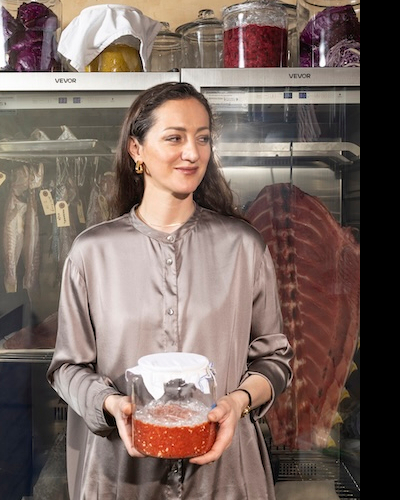
Born in Prishtina, Kosovo, Fjölla Sheholli’s early years were shaped by political upheaval and her family’s resilience in the face of uncertainty. Her father worked within a national institution during a time when scholars and policymakers shaped the country’s direction. But as tensions escalated in the late 1980s and early 1990s, war disrupted daily life, forcing families—including hers—to adapt in order to survive.
With mass layoffs and food shortages, self-sufficiency became essential. Fjölla spent much of her childhood on her grandmother’s farm, where she learned to raise animals, grow vegetables, make butter and cheeses, ferment, and preserve food. These were not romantic traditions—they were practical skills rooted in necessity.
Her family’s connection to nature extended beyond the farm. Much of her childhood was spent outdoors, hunting, fishing, and foraging near their lake house and in the surrounding mountains. Nature was never something to conquer or extract from, but something to work with. Foraging meant tending to the land, understanding seasons, and taking only what could be replenished. This early relationship with the natural world formed the foundation of her philosophy: responsibility to the land must always accompany nourishment from it.
When Fjölla met Junayd Juman, their shared curiosity for seasonality, forgotten ingredients, and regenerative practices shaped a vision that would define their culinary philosophy. Traveling throughout the Northeast to source ingredients, Fjölla began rediscovering wild plants and edible “weeds” that mirrored those from her childhood in Kosovo—species often overlooked or dismissed in modern cuisine.
Together, they envisioned a restaurant that would not merely serve food, but tell the story of the land and the people connected to it. Inspired by indigenous knowledge, regenerative farming, and micro-seasonality, they sought to reflect the natural rhythms of the region. That vision became Honey Badger.
The restaurant challenges conventional dining structures. There is no rigid separation between front and back of house; the team sources, cooks, and presents each dish collectively. They work with nature rather than imposing upon it, honoring ingredients in their fullest expression. Beyond the kitchen, Fjölla’s background in classical piano and cello continues to inform her work—instilling discipline, sensitivity, and an awareness of timing and rhythm. Her cooking, like music, relies on restraint, intention, and knowing when to let something speak for itself.
At Honey Badger, every meal reflects Fjölla’s journey—a convergence of heritage, stewardship, and the belief that food should be deeply rooted in place.